
Property packages you can see inside
Every separation and every reactor rests on the phase equilibrium and the properties underneath it. AI Process Simulator lets you choose the method, edit its parameters, draw its phase diagrams, and check it against published data.
A component list, a method, and the options that matter
A fluid package is the components and the thermodynamic method a stream is calculated with. Build as many as you need in the Fluid Package Manager, and give each stream, or each sub-flowsheet, the one that suits it.
- Activity models take a vapour-phase model of their own: Ideal, RK, SRK or Peng-Robinson
- Liquid density by COSTALD or by the equation of state
- Free water: the immiscible water phase, simplified or rigorous
- Streams on different packages are reconciled wherever they meet, and nothing is dropped silently

Equations of state and activity models
The choice between the two families is the most consequential one in a simulation. Both are here, and each tells you plainly what it can and cannot do for your components.
| Method | Family | Typical use |
|---|---|---|
| Peng-Robinson (PR) | Cubic equation of state | Natural gas, gas processing, refining, hydrocarbon systems at any pressure |
| PRSV | Peng-Robinson with the Stryjek–Vera alpha function | Better vapour pressures, including for polar components |
| Soave-Redlich-Kwong (SRK) | Cubic equation of state | Gas and light-hydrocarbon systems |
| NRTL | Activity-coefficient model | Strongly non-ideal liquids: water, alcohols, azeotropes, liquid–liquid splits |
| UNIFAC, UNIFAC-LL, UNIFAC-NIST | Predictive group contribution | Non-ideal systems with no measured binary data; separate published parameter sets for vapour–liquid and liquid–liquid work |
| Ideal | Raoult’s law | Near-ideal mixtures, quick checks and teaching |
| Incompressible | Single-fluid package | Heat-transfer fluids and thermal oils |
Liquid density by COSTALD
Cubic equations are 5 to 25% off on liquid volume. The equation-of-state packages use COSTALD for liquid density by default, which lands within 1.9% of NIST on the reference set.
Binary interaction parameters
Edit kij for the equations of state and the NRTL coefficients pair by pair. Parameters that arrive in a case file stay with that case and never change your other work.
Every flash you need
Temperature–pressure, pressure–enthalpy, pressure–entropy, temperature–entropy and vapour-fraction flashes, with a free-water three-phase flash where water drops out.
Draw the equilibrium you are actually solving with
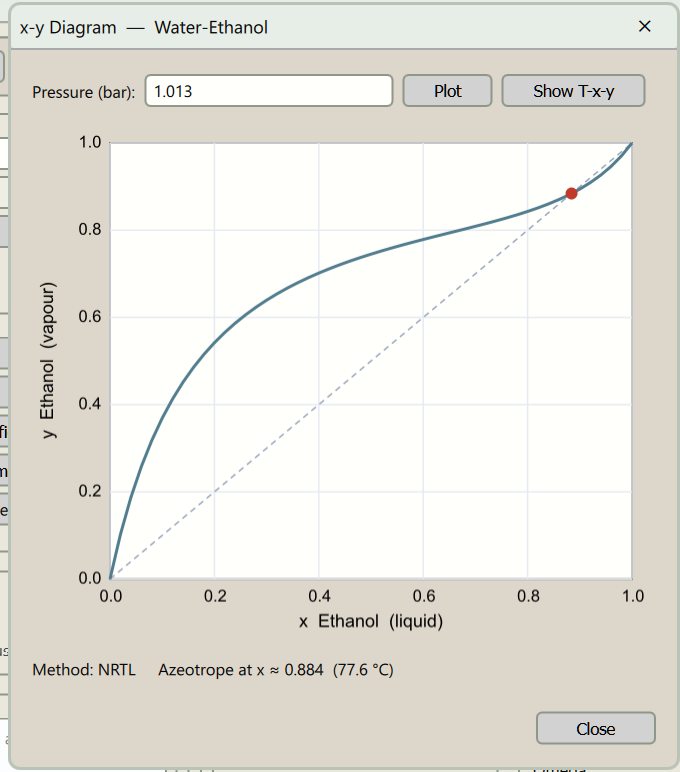
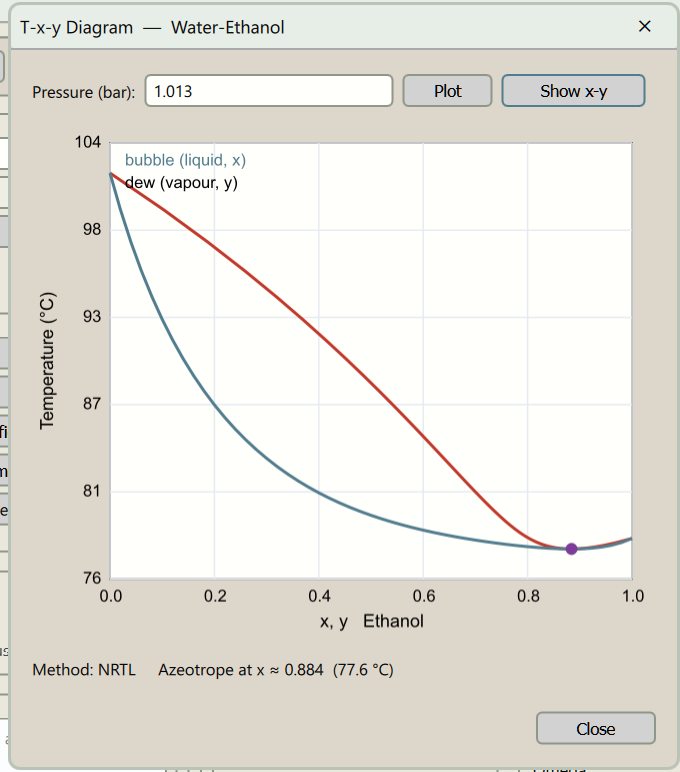
x–y and T–x–y diagrams, McCabe–Thiele and residue curve maps come straight from the fluid package in use: the same method, the same parameters, the same components. If a column will not reach the purity you want, the diagram from your own package shows whether it can.
362 pure components, and room for yours
The Component Manager holds every compound with its formula, CAS number, critical properties, acentric factor and ideal-gas heat capacity. Add your own compounds and build component lists for your packages.
- Hydrocarbons, light gases, water, acid gases, alcohols, aromatics and more
- Ideal-gas heat capacities checked against NASA-7 published coefficients
- Pseudo-components from the Oil Manager sit beside the pure ones

From a crude assay to pseudo-components
The Oil Manager turns a laboratory assay into pseudo-components a column can use: enter the distillation curve and bulk properties, add the light ends, set the cut points, and characterize.
- Five crude assays included: Brent, Arab Light, West Texas Intermediate, Western Canadian Select and Venezuelan Heavy
- The back end extrapolated, and every assumption reported in the diagnostics
- Pseudo-component properties from the Riazi, Twu and Lee–Kesler correlations
- Export the set to the Component Manager and use it in any package

Tested against the references
Water and steam against IAPWS-IF97. The component database against reference equations of state. Ideal-gas heat capacities against NASA-7. The water–ethanol azeotrope against CoolProp and the literature, at two pressures.
